
On this page
Land acknowledgement
We have prepared this report in the Ottawa-Gatineau region, the traditional territory of the Algonquin Anishinaabeg peoples. They have lived on this territory for millennia. Their culture and presence have nurtured this land and continue to do so. The Tribunal members and staff honour all First Nations, Inuit and Métis peoples of Canada, their valuable past and their ongoing contributions to the land that we all share.
We invite you to join the journey to reconciliation and to learn more about all First Nations, Inuit and Métis peoples of Canada.
We recognize that we still have much to do; reconciliation is an ongoing process for us all. Our goal is to contribute to reconciliation in a meaningful way.
A message from the Chairperson
June 30, 2026
Pursuant to section 41 of the Canadian International Trade Tribunal Act, it is my privilege to present the annual report of the Canadian International Trade Tribunal for the period from April 1, 2025, to March 31, 2026. This report highlights the Tribunal’s activities, accomplishments and challenges over the past fiscal year.
The year unfolded amid significant uncertainty and structural change in the global trading environment, marked by evolving supply chains, shifting trade patterns, increasing trade tensions and growing pressures on domestic industries. These developments underscored the importance of stable, transparent and rules-based institutions that support confidence and predictability in Canada’s trade and procurement systems. Against this backdrop, the Tribunal experienced a significant and unprecedented increase in its caseload across all mandates. In this increasingly complex environment, the Tribunal’s work remained essential to the fair, timely and independent adjudication of matters of critical economic importance to Canadian producers, importers and consumers.
In particular, the Tribunal experienced historically high levels of activity in both trade remedies and customs appeals, including a record number of enforcement appeals filed under the Special Import Measures Act, relating to determinations made by the Canada Border Services Agency.
Following a direction from the Governor in Council, on the recommendation of the Minister of Finance, the Tribunal initiated its first safeguard inquiry in nearly a decade regarding vegetable goods. The inquiry involves matters of significant economic and public importance and reflects the increasingly complex and consequential trade matters coming before the Tribunal. The Tribunal will report its findings and any recommendations in the next year. The Tribunal is directed, if it makes an affirmative determination, to recommend the most appropriate remedy and to consider the effect of the remedy on the affordability for consumers of certain vegetable goods, and on food security.
This fiscal year also saw amendments to the Procurement Inquiry Regulations. These amendments updated aspects of the procurement complaint framework, including provisions relating to remedies and compensation. The Tribunal continued to see a steady increase in procurement complaints and administered its procurement mandate in accordance with the legislative and regulatory framework established by Parliament and the Governor in Council.
As the complexity, scale and urgency of proceedings before the Tribunal continued to increase, so too did the operational demands associated with ensuring complete and reliable evidentiary records and the timely conduct of proceedings. During the fiscal year, the Tribunal issued historically high numbers of disclosure and production orders and initiated contempt proceedings for the first time. These developments reflect the Tribunal’s commitment to making decisions based on comprehensive and reliable information, in accordance with its statutory mandates and procedural fairness obligations.
Throughout this period of heightened activity, the Tribunal exercised the powers conferred upon it under the Canadian International Trade Tribunal Act with diligence, restraint and fairness, while adapting its processes to support transparent, efficient and effective adjudication. The sustained growth in the volume and complexity of proceedings also highlighted the importance of ensuring that the Tribunal remains equipped to respond promptly and effectively to an increasingly demanding mandate. These developments reinforce the importance of maintaining institutional agility and operational readiness in support of the Tribunal’s mandate.
This year also marked an important transition for the Tribunal with the retirement of former Chairperson Frédéric Seppey in December 2025, following 33 years of distinguished service to Canadians, including five years as Chairperson of the Tribunal. Throughout his tenure, Mr. Seppey demonstrated exceptional leadership, deep expertise in international trade and public policy, and an unwavering commitment to fairness, transparency and institutional excellence. His contributions have left a lasting impact on the Tribunal and on Canada’s trade and adjudicative communities more broadly.
It is an honour to assume the role of Chairperson at this time of profound change in the international trade landscape. As the global trading environment is expected to remain complex and uncertain in the years ahead, I remain confident in the strength of the institution, the expertise and dedication of those who support the Tribunal’s work, and the Tribunal’s continued ability to adapt, innovate and respond to evolving demands while upholding the principles of fairness, independence, transparency and procedural integrity that underpin its mandate. The Tribunal will continue to evolve to support accessible, efficient and effective adjudication while remaining firmly grounded in the principles that underpin public confidence in its work.
Finally, I would like to express my sincere thanks to the Members of the Tribunal for their professionalism, expertise and steadfast commitment throughout an exceptionally demanding year. Their careful consideration of the matters before them and their continued dedication to fairness, independence and procedural integrity remain fundamental to the fulfillment of the Tribunal’s mandate.
I would also like to recognize, with great appreciation, the staff who support the Tribunal’s work, for their professionalism, dedication and adaptability in responding to the significant operational demands experienced throughout the year. Their expertise and commitment play an essential role in supporting the Tribunal’s ability to fulfill its mandate effectively, efficiently and independently in service to Canadians.
Bree Jamieson-Holloway
Chairperson
Our year in numbers
Trade remedy inquiries
- The effects of the Special Import Measures Act (SIMA) duties applied to approximately $3.3 billion of imports and $17.2 billion of shipments in industries employing 43,728 people.
Procurement reviews
- The Tribunal received 91 complaints about federal government procurement processes estimated to represent over $337 million in federal contracts.
Customs and excise appeals
- Interesting products: speed ovens and convection microwave ovens, surgical table covers and different types of face masks.
Across all mandates
- Hearing days: 47
- in-person: 6
- virtual: 11
- hybrid: 30
- File hearings: 102
- Decisions issued: 118
- Pages on the records: 600,467
- Over 126 witnesses appeared before the Tribunal in customs appeals and trade remedy inquiries, demonstrating the often-complex nature of these cases.
What we do
The Canadian International Trade Tribunal is recognized, in Canada and on the international stage, for its ability to adjudicate trade disputes in a rigorous, fair, transparent and timely fashion. The Tribunal provides Canadian and international businesses with decisions and determinations on trade remedy inquiries, federal government procurement inquiries, and customs duties and excise tax appeals. At the request of the Government, the Tribunal can also provide advice in economic and tariff matters.
The Tribunal is a quasi-judicial institution that is independent of the Government. It has all the powers, rights and privileges vested in a superior court of record concerning matters necessary or proper for the exercise of its jurisdiction. The Tribunal reports to Parliament through the Minister of Finance. It conducts its proceedings as informally and expeditiously as possible.
The Tribunal has little control over the volume and complexity of its workload and faces tight statutory deadlines for most of its cases.
Trade remedy inquiries
Under the Special Import Measures Act (SIMA), the Tribunal determines whether the dumping or subsidizing of imported goods has caused injury or is threatening to cause injury to a domestic industry. Dumping means that foreign producers are selling their goods in the Canadian market for less than the price of similar goods in their home markets or at prices that do not cover costs and a reasonable amount for profits. Subsidizing means that foreign producers have benefited from certain types of financial or other supports by foreign governments. These practices may result in imports flooding the Canadian market at low prices, disrupting supply chains and harming Canadian producers of these goods and, ultimately, the people employed to make those goods.
If the Tribunal determines that imported goods are causing injury or threatening to cause injury to a domestic industry, then anti-dumping or, in the case of subsidizing, countervailing duties apply to the imports for a period of five years. A finding of injury or threat of injury expires after five years unless the Tribunal continues it following an expiry review. A finding can also be rescinded early under certain circumstances.
Procurement inquiries
The Tribunal inquires into complaints by potential suppliers of certain goods or services. It decides whether the federal government broke its procurement obligations under certain trade agreements. It considers whether bids were evaluated fairly and according to the terms and conditions of a procurement process. The Tribunal can recommend remedies and award costs.
Customs and excise appeals
The Tribunal hears and decides appeals of decisions made by the Canada Border Services Agency under the Customs Act and SIMA. Appeals under the Customs Act relate to tariff classification, value for duty and the origin of imported goods. Appeals under SIMA relate to whether certain goods fall within the scope of trade remedy measures or to the normal value, export price or amount of subsidy in relation to imported goods subject to an injury finding. The Tribunal also hears and decides appeals of decisions of the Minister of National Revenue made under the Excise Tax Act. These appeals relate to assessments or determinations of excise tax.
Safeguard inquiries
International trade rules allow Canada to temporarily restrict imports to allow Canadian producers to adapt to increased imports which cause or threaten to cause serious injury. These temporary measures are called safeguards. The Tribunal inquires into safeguard complaints from Canadian producers and conducts safeguard references upon request from the Government of Canada.
Economic and tariff inquiries
The Government of Canada, by way of the Governor in Council or the Minister of Finance, may direct the Tribunal to inquire into and provide advice on economic, trade or tariff issues.
Who we are
History of the Canadian International Trade Tribunal
The Tribunal has a long and rich history.
| 1888 | The Board of Customs is established. Its powers include the review of matters such as value for duty, the re-determination of a rate of duty or the exemption of a good from duty. The decisions of the Board are subject to the approval of the Minister of Revenue. |
|---|---|
| 1904 | Canada adopts its first anti-dumping legislation. It is among the first countries in the world to have such legislative tools. Under this legislation, duties are automatically applied to dumped goods, without case-by-case investigations. |
| 1931 | The Tariff Board is established as a successor to the Board of Customs, and Board of Customs appellate powers are transferred to the Tariff Board. It is a court of record, independent from Customs. In addition to the appeal powers held by the Board of Customs, the Tariff Board inquires into economic matters referred to it by the Minister of Finance. |
| 1968 | The Anti-dumping Tribunal is established, following the adoption of the General Agreement on Tariffs and Trade Anti-Dumping Code. The application of anti‑dumping duties is, from now on, subject to a determination by an independent tribunal of whether the dumping has caused material injury to domestic production. |
| 1969 | The Anti-dumping Tribunal becomes the Canadian Import Tribunal to reflect a broader mandate to conduct injury inquiries in both anti-dumping and countervailing duty proceedings under the newly adopted Anti-dumping Act, as well as in safeguard cases. |
| 1970 | The Textile and Clothing Board is formed and inquires into safeguard complaints by the Canadian textile and apparel industries. |
| 1988 | The Canadian International Trade Tribunal (CITT) begins operations following the merger of the Tariff Board, the Canadian Import Tribunal and the Textile and Clothing Board. |
| 1994 | The Tribunal absorbs the Procurement Review Board, established in 1988, extending the Tribunal’s mandate to include inquiries into whether federal procurement processes have been conducted in accordance with Canada’s domestic and international trade obligations. |
| 2014 | The Administrative Tribunals Support Service of Canada (ATSSC) is established to provide operational support and corporate services to a group of tribunals, including the CITT. Staff and resources associated with the CITT Secretariat are transferred to the new entity while remaining mainly dedicated to the CITT. |
Legend
| customs appeals |
| dumping and subsidizing |
| first merger |
| second merger and procurement reviews (all mandates of the Tribunal to this date) |
Members of the Tribunal
The Tribunal may be composed of up to seven full-time permanent members, including the Chairperson and the Vice-Chairperson. In addition to their duties as a member of the Tribunal, the Chairperson assigns cases to members and manages the Tribunal’s work. Permanent members are appointed by the Governor in Council for a term of up to five years, which can be renewed once. Up to five temporary members may also be appointed. Members have a variety of educational backgrounds and experience.
Frédéric Seppey was the Chairperson of the Tribunal until December 31, 2025, when his term ended. Bree Jamieson-Holloway was appointed as Chairperson on March 19, 2026. In 2025-26, the Tribunal operated with seven permanent members and three temporary members. As of March 31, 2026, the Tribunal’s members are:

Susan Beaubien
(Permanent member, mandate effective until March 20, 2029)

Cheryl Beckett
(Permanent member, mandate effective until November 23, 2028)

Georges Bujold
(Permanent member, mandate effective until November 23, 2028)

Serge Fréchette
(Temporary part-time member, mandate effective until June 9, 2027)

Randolph W. Heggart
(Temporary full-time member, mandate effective until June 23, 2026)

Bree Jamieson-Holloway
(Chairperson, mandate effective until December 4, 2027)

Susana Lee
(Permanent member, mandate effective until January 28, 2029)

Elizabeth Whitsitt
(Permanent member, mandate effective until October 6, 2029)

Eric Wildhaber
(Temporary full-time member, mandate effective until July 24, 2028)
The support services to the Tribunal
The Tribunal is supported by employees of the Administrative Tribunals Support Service of Canada (ATSSC).
The ATSSC is responsible and accountable for providing support services and facilities to the Tribunal and to 12 other federal administrative tribunals. These services include the specialized services required to support the mandate of each tribunal (e.g., registry, legal services and trade investigation services for the CITT), as well as internal services (human resources, financial services, information management and technology, accommodation, security, planning and communications).
Registry services
The registry team ensures the effective management of the administrative processes related to the Tribunal’s mandates. It provides administrative support to the Tribunal to ensure that cases are handled as informally and expeditiously as possible. The registry team also liaises between the Tribunal and parties to a proceeding. Its main responsibilities are to:
- communicate with parties on behalf of the Tribunal;
- compile the exhibits on behalf of the Tribunal to produce the official case record;
- manage the logistics of the Tribunal’s in-person, virtual and hybrid hearings; and
- issue decisions on behalf of the Tribunal.
Trade remedies investigations branch
The trade remedies investigations branch (TRIB) is composed of data services advisors and economic analysts. TRIB supports the Tribunal by providing economic data and analysis in dumping and subsidizing cases, primarily by developing questionnaires and using the information received to produce investigation reports on the market for the goods under investigation. TRIB also provides economic advice and analysis to Tribunal members on discrete economic issues that arise in the course of investigations and deliberations.
Editing services
The Editing services team edits and translates Tribunal decisions as well as various documents. It also publishes content on the Tribunal’s website and prepares communication products.
Legal services
The legal services team provides legal research and advice to members in support of the Tribunal’s mandates, as well as various legal support services in the conduct of proceedings before the Tribunal.
Caseload
The Tribunal has experienced a significant increase in the number of trade remedies cases, particularly preliminary injury inquiries and final injury inquiries, along with a notable rise in enforcement appeals. The caseload has remained steady with respect to procurement reviews, dumping and subsidizing expiry reviews and customs appeals. The table below contains some key indicators in this regard.
| Cases received | Total decisions/reports issued | |||||||||
|---|---|---|---|---|---|---|---|---|---|---|
| 2025-26 | 2024-25 | 2023-24 | 2022-23 | 2021-22 | 2025-26 | 2024-25 | 2023-24 | 2022-23 | 2021-22 | |
| Trade remedies | ||||||||||
| Preliminary injury inquiries (PI) | 10 | 5 | 2 | 0 | 6 | 10 | 4 | 1 | 2 | 4 |
| Final injury inquiries (NQ) | 9 | 3 | 1 | 1 | 6 | 6 | 3 | 1 | 1 | 9 |
| Interim reviews (RD) | 1 | 0 | 1 | 0 | 0 | 1 | 1 | 0 | 0 | 1 |
| Expiry reviews (RR) | 9 | 8 | 9 | 5 | 6 | 8 | 10 | 6 | 6 | 4 |
| Public interest inquiries (PB) | 0 | 3 | 0 | 0 | 1 | 3 | 0 | 0 | 0 | 1 |
| Safeguard inquiries | ||||||||||
| Safeguard (GC) | 1 | 0 | 0 | 0 | 0 | 0 | 0 | 0 | 0 | 0 |
| Procurement reviews | ||||||||||
| Procurement (PR) | 91 | 86 | 66 | 79 | 89 | 77 | 76 | 61 | 74 | 98 |
| Customs and excise appeals | ||||||||||
| Appeals (AP) | 33 | 32 | 27 | 43 | 44 | 77 | 76 | 61 | 74 | 98 |
| Enforcement appeals (EA) | 21 | 9 | 8 | 4 | 6 | 1 | 1 | 2 | 3 | 4 |
| Extensions of time (EP) | 3 | 1 | 2 | 4 | 2 | 0 | 0 | 4 | 2 | 1 |
Disclosure and production orders
The Tribunal saw a notable increase in the use of disclosure and production orders from the previous fiscal year, with disclosure orders increasing from 17 to 51 and production orders from 3 to 26. The increase reflects the growing complexity of matters coming before the Tribunal, including proceedings involving emerging industries, evolving commercial practices, and increasingly sophisticated and data-intensive evidentiary records. In these circumstances, the Tribunal has taken a proactive approach to ensuring that it has the complete, accurate and reliable information necessary to fairly and properly determine the matters before it.
This approach is grounded in the Tribunal’s statutory authority under the Canadian International Trade Tribunal Act, including section 17 of the Act, which grants the Tribunal, in matters necessary for the exercise of its jurisdiction, the powers, rights, and privileges of a superior court of record, including with respect to the production and inspection of documents and the examination of witnesses. The Tribunal will continue to require parties to comply fully and promptly with its rules, directions and requests for information in order to support fair, efficient, and evidence-based decision-making and to ensure that it can effectively fulfill its mandate.
Dumping and subsidizing injury inquiries and expiry reviews
Canada’s trade remedy system under the Special Import Measures Act (SIMA) is bifurcated. The Canada Border Services Agency (CBSA) is responsible for determining whether imports of goods into Canada:
- have been sold at prices lower than the price of similar goods in the foreign producer’s home market or at prices that do not cover costs and a reasonable amount for profits (dumping); or
- have benefited from certain types of government grants or other assistance from foreign governments (subsidizing).
The Tribunal is responsible for determining whether the dumping or subsidizing has caused injury or threat of injury to the domestic industry or has caused delay to the establishment of a domestic industry. The CBSA may collect anti-dumping and countervailing duties if a Canadian domestic industry is injured by the importation of dumped and subsidized goods into Canada.
Special Import Measures Act process chart
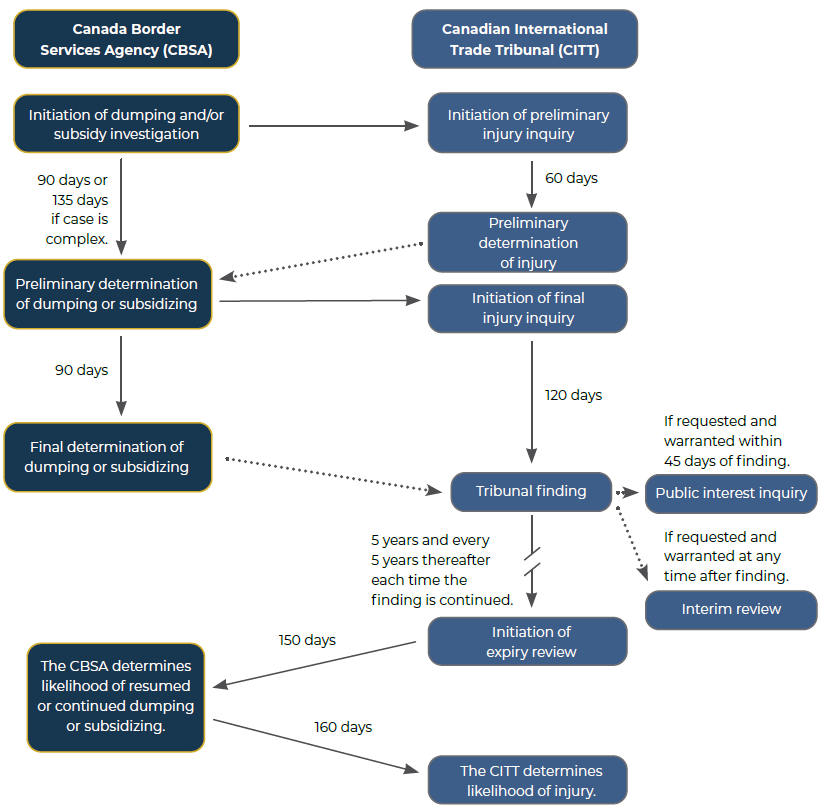
The following diagram illustrates the investigative process under the Special Import Measures Act.
Special Import Measures Act process chart - Text description
From the date an investigation is initiated, the CBSA has 90 days (or 135 days if the case is complex) to either terminate the action or issue a preliminary determination.
The Tribunal, after the receipt of a notice of an initiation, conducts a preliminary injury inquiry. It must complete this inquiry within 60 days.
The CBSA makes a final determination regarding the dumping and subsidizing within a further 90 days.
The Tribunal’s final injury inquiry lasts 120 days and it must issue its finding within that timeframe.
Public interest inquiries can be initiated by the Tribunal itself or upon request from an interested party within 45 days of finding.
The Tribunal can initiate an interim review on its own or at the request of an interested party at any time after the issuance of the finding.
An expiry review must be initiated no later than five years after the Tribunal’s decision in the final injury inquiry or after the Tribunal’s decision in a previous expiry review.
Once an expiry review is initiated, the CBSA has 150 days to determine whether the expiry of the duties is likely to result in the continuation or resumption of dumping or subsidizing. If the CBSA determines that such likelihood exists, the Tribunal then has 160 days to conduct its inquiry to determine whether the expiry of the duties is likely to harm the domestic industry.
Injury inquiries
Preliminary injury inquiries (PI)
The CBSA generally initiates a dumping or subsidizing investigation following a complaint from a domestic producer. If the CBSA initiates a dumping or subsidizing investigation, the Tribunal initiates a preliminary injury inquiry under SIMA.
In a preliminary injury inquiry, the Tribunal determines whether the evidence discloses a reasonable indication that the dumping or subsidizing has caused injury or retardation or is threatening to cause injury.
If there’s no reasonable indication that the dumping or subsidizing has caused injury or retardation or is threatening to cause injury, the Tribunal terminates the inquiry, and the CBSA terminates the dumping or subsidizing investigation. The Tribunal issues a determination, within 60 days of the initiation of the preliminary injury inquiry, and reasons.
| PI-2024-004 | PI-2024-005 | PI-2025-001 | PI-2025-002 | PI-2025-003 | PI-2025-004 | |
|---|---|---|---|---|---|---|
| Product | Renewable Diesel | Polyethylene Terephthalate | Carbon and Alloy Steel Wire | Steel Strapping | Thermal Paper Rolls | Cast Iron Soil Pipe |
| Type of case | Dumping and subsidizing | Dumping and subsidizing | Dumping | Dumping and subsidizing | Dumping and subsidizing | Dumping and subsidizing |
| Country or countries | United States | China and Pakistan | China, Chinese Taipei, India, Italy, Malaysia, Portugal, Spain, Thailand, Türkiye, and Vietnam | China, South Korea, Türkiye, and Vietnam | China | China |
| Date of decision | May 5, 2025 | May 20, 2025 | June 19, 2025 | July 10, 2025 | August 11, 2025 | September 9, 2025 |
| Determination | No reasonable indication of injury | Reasonable indication of injury | Reasonable indication of injury | Reasonable indication of injury | Reasonable indication of injury | Reasonable indication of injury |
| Participants | ||||||
| 2 | 0 | 4 | 0 | 0 | 2 |
| 4 | 0 | 6 | 0 | 0 | 1 |
| 8 | 6 | 12 | 4 | 5 | 6 |
| Total | 14 | 6 | 22 | 4 | 5 | 9 |
| PI-2025-005 | PI-2025-006 | PI-2025-007 | PI-2025-008 | PI-2025-009 | PI-2025-010 | |
|---|---|---|---|---|---|---|
| Product | Oil Country Tubular Goods | Thermoformed Molded Fiber Tableware | Truck Bodies | Forged Grinding Media | Certain Oil and Gas Well Casing | Certain Unarmoured Building Cables |
| Type of case | Dumping | Dumping and subsidizing | Dumping and subsidizing | Dumping and subsidizing | Dumping | Dumping and subsidizing |
| Country or countries | Mexico, Philippines, South Korea, Türkiye, and the United States | China | China | China | Austria and the United States | China |
| Date of decision | October 9, 2025 | December 12, 2025 | December 23, 2025 | March 11, 2026 | N/A | N/A |
| Determination | Reasonable indication of injury | Reasonable indication of injury | Reasonable indication of injury | Reasonable indication of injury | Pending | Pending |
| Participants | ||||||
| 2 | 1 | 1 | 1 | 1 | TBD |
| 3 | 1 | 2 | 0 | 2 | TBD |
| 7 | 2 | 0 | 2 | 3 | TBD |
| Total | 12 | 4 | 3 | 3 | 6 | TBD |
Final injury inquiries (NQ)
If the CBSA makes a preliminary determination of dumping or subsidizing, the Tribunal commences a final injury inquiry pursuant to SIMA. The CBSA may levy provisional duties on imports from the date of the preliminary determination, and it continues its investigation until it makes a final determination of dumping or subsidizing.
The Tribunal must issue its finding of injury within 120 days from the date of the CBSA’s preliminary determination of dumping or subsidizing. The Tribunal has an additional 15 days to issue reasons supporting its finding. A Tribunal finding of injury or retardation or threat of injury to a domestic industry is required for the imposition of definitive anti-dumping or countervailing duties by the CBSA. The finding remains in place for up to five years.
The Tribunal completed five final injury inquiries this fiscal year. These matters concerned polyethylene terephthalate (“PET”) resin, steel wire, thermal paper rolls, steel strapping and cast iron soil pipe. The Tribunal also terminated its inquiry concerning corrosion-resistant steel sheet. Three other final injury inquiries, concerning oil country tubular goods, thermoformed molded fibre tableware and truck bodies, were initiated and are ongoing at the end of the fiscal year.
| NQ-2025-001 | NQ-2025-002 | NQ-2025-003 | NQ-2025-004 | NQ-2025-005 | |
|---|---|---|---|---|---|
| Product | Corrosion-resistant Steel | Polyethylene Terephthalate | Carbon and Alloy Steel Wire | Thermal Paper Rolls | Steel Strapping |
| Type of case | Dumping | Dumping and subsidizing | Dumping | Dumping and subsidizing | Dumping and subsidizing |
| Country | Türkiye | China, Pakistan | China, Chinese Taipei, India, Italy, Malaysia, Portugal, Spain, Thailand, Türkiye, and Vietnam | China | China, South Korea, Türkiye, and Vietnam |
| Date of finding | July 21, 2025 | October 15, 2025 | January 2, 2026 | January 8, 2026 | January 14, 2026 |
| Finding | Terminated (no injury) | Injury | Injury, in part | Injury | Injury |
| Questionnaires received | 72 | 46 | 100 | 83 | 97 |
| Witnesses heard | 14 | 15 | 19 | 8 | 6 |
| Participants | |||||
| 3 | 2 | 5 | 4 | 1 |
| 2 | 7 | 5 | 1 | 2 |
| 2 | 0 | 14 | 1 | 0 |
| Total | 7 | 9 | 24 | 6 | 3 |
| NQ-2025-006 | NQ-2025-007 | NQ-2025-008 | NQ-2025-009 | |
|---|---|---|---|---|
| Product | Cast Iron Soil Pipe | Oil Country Tubular Goods | Thermoformed Molded Fiber Tableware | Truck Bodies |
| Type of case | Dumping and subsidizing | Dumping | Dumping and subsidizing | Dumping and subsidizing |
| Country | China | Mexico, Philippines, South Korea, Türkiye, and the United States | China | China |
| Date of finding | February 6, 2026 | N/A | N/A | N/A |
| Finding | Injury | Pending | Pending | Pending |
| Questionnaires received | 34 | 58 | TBD | TBD |
| Witnesses heard | 10 | 20 | TBD | TBD |
| Participants | ||||
| 2 | 5 | TBD | TBD |
| 1 | 3 | TBD | TBD |
| 2 | 7 | TBD | TBD |
| Total | 5 | 15 | TBD | TBD |
Expiry reviews (RR)
Under SIMA, an order or a finding ordinarily expires after five years, unless it is continued by the Tribunal following the conduct of an expiry review. There are two phases in an expiry review.
The first phase is the investigation by the CBSA to determine whether there is a likelihood of resumed or continued dumping or subsidizing if the order or finding expires.
If the CBSA determines that such likelihood exists with respect to any of the goods, the second phase is the Tribunal’s inquiry into the likelihood of injury or retardation arising from the resumption or continuation of the dumping or subsidizing. If the CBSA determines that there is no likelihood of resumed dumping or subsidizing for any of the goods, the Tribunal issues an order rescinding the order or finding with respect to those goods.
Upon completion of an expiry review, the Tribunal issues an order with reasons, rescinding or continuing an order or finding, with or without amendment. If an order or finding is continued, it remains in force for a further five years, unless an interim review is initiated, and the order or finding is rescinded. If the order or finding is rescinded, imports are no longer subject to anti‑dumping or countervailing duties.
The Tribunal completed seven expiry reviews this fiscal year. These reviews concerned silicon metal, thermoelectric containers, circular copper tube, structural tubing, aluminum extrusions, hot-rolled carbon steel plate and carbon steel screws. In addition, the Tribunal terminated an expiry review concerning hot-rolled carbon steel plate from Ukraine as the review was not supported by domestic producers.
The Tribunal also initiated seven expiry reviews which were still in progress at the end of the fiscal year. These reviews concerned concrete reinforcing bar, corrosion-resistant steel sheet, oil country tubular goods (two separate reviews), heavy plate, photovoltaic modules and laminates, and wheat gluten.
| RR-2024-002 | RR-2024-003 | RR-2024-004 | RR-2024-005 | RR-2024-007 | RR-2024-008 | RR-2025-001 | RR-2025-002 | |
|---|---|---|---|---|---|---|---|---|
| Product | Silicon Metal | Thermoelectric Containers | Circular Copper Tube | Structural Tubing | Aluminum Extrusions | Hot-rolled Carbon Steel Plate | Carbon Steel Screws | Concrete Reinforcing Bar |
| Type of case | Dumping and Subsidizing | Dumping and subsidizing | Dumping and subsidizing | Dumping | Dumping and subsidizing | Dumping | Dumping and Subsidizing | Dumping and subsidizing |
| Country or countries | China | China | Brazil, Greece, China, South Korea and Mexico | South Korea, Türkiye | China | Brazil, Denmark, Indonesia, Italy, Japan and South Korea | China, Chinese Taipei | China, South Korea and Türkiye |
| Date of decision | April 30, 2025 | June 2, 2025 | June 18, 2025 | July 16, 2025 | October 1, 2025 | December 17, 2025 | March 11, 2026 | N/A |
| Decision | Order continued | Order continued | Order continued | Order continued | Order continued | Finding continued | Finding continued | Pending |
| Questionnaires received | 11 | 29 | 39 | 37 | 53 | 62 | 72 | 40 |
| Witnesses heard | 7 | 0 | 0 | 14 | 14 | 8 | 0 | 0 |
| Participants | ||||||||
| 2 | 2 | 1 | 4 | 11 | 2 | 3 | 5 |
| 0 | 0 | 0 | 0 | 0 | 4 | 0 | 0 |
| 1 | 1 | 1 | 0 | 3 | 4 | 13 | 3 |
| Total number of participants | 3 | 3 | 2 | 4 | 14 | 10 | 16 | 8 |
| * “0” witnesses means that these expiry reviews had file hearings (hearing by way of written submissions). | ||||||||
Historical trend: Dumping and subsidizing
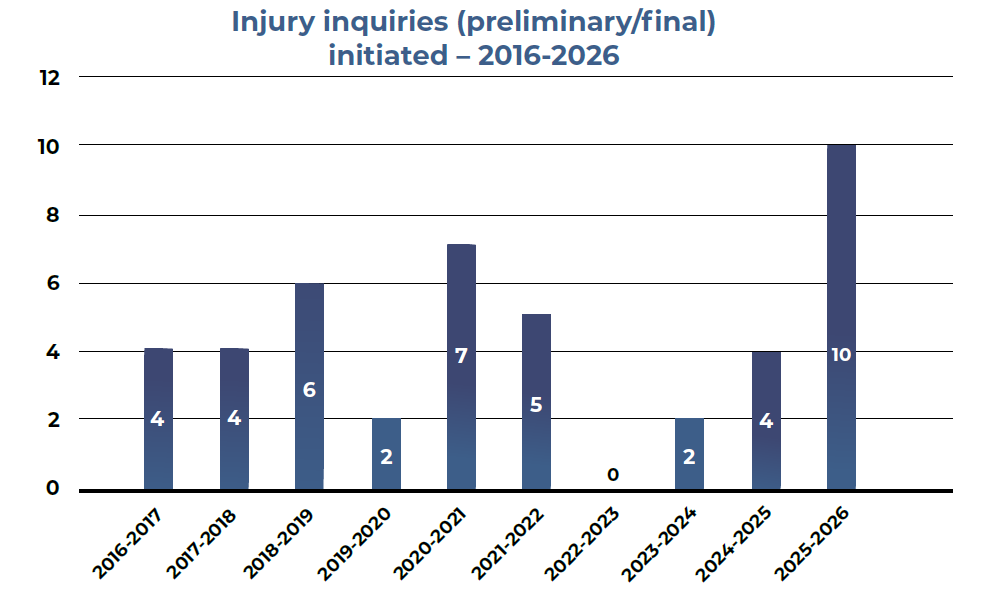
The Tribunal continues to experience a long-term trend increase in SIMA-related activity, reaching historical highs in 2025-26, with elevated levels expected to persist through fiscal year 2026-27. This is due, in part, to a challenging global trade environment and a high percentage of inquiries and reviews that result in the imposition or the continuation of trade remedy measures. The following graph shows the evolution of the number of injury inquiries initiated over the past decade.
Injury inquiries (preliminary/final)initiated – 2016-2026 - text description
Bar chart of injury inquiries from 2016 to 2026.
- 2016–2017: 4
- 2017–2018: 4
- 2018–2019: 6
- 2019–2020: 2
- 2020–2021: 7
- 2021–2022: 5
- 2022–2023: 0
- 2023–2024: 2
- 2024–2025: 4
- 2025–2026: 10
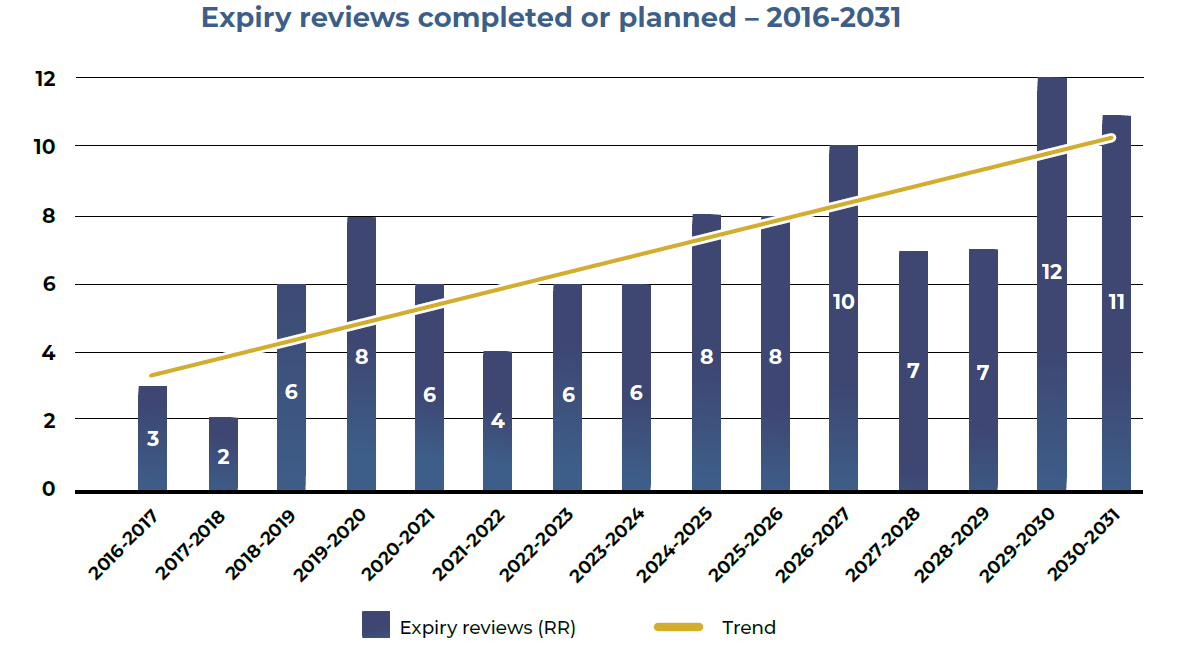
The number of expiry reviews completed each year has gradually increased over a ten-year period, from an average of five expiry reviews for the 2016-21 period to just over six for the 2021-26 period. As shown in the following graph, this creates a cyclical but gradual upward trend pressure on the caseload of the Tribunal. For example, there are now 57 injury findings in force
Expiry reviews completed or planned2016-2031 - text description
Bar chart of expiry reviews from 2016 to 2031 and trend.
- 2016–2017: 3
- 2017–2018: 2
- 2018–2019: 6
- 2019–2020: 8
- 2020–2021: 6
- 2021–2022: 4
- 2022–2023: 6
- 2023–2024: 6
- 2024–2025: 8
- 2025–2026: 8
- 2026–2027: 11
- 2027–2028: 7
- 2028–2029: 7
- 2029–2030: 12
- 2030–2031: 11
Interim reviews (RD)
An interim review is a proceeding through which the Tribunal may, at any time, reconsider its findings of injury or threat of injury, or other related orders on its own initiative or at the request of the Minister of Finance, the CBSA or any other interested person or government.
An interim review may be warranted where there is a reasonable indication that new facts have arisen or if the circumstances that led to the finding or order have changed. In an interim review, the Tribunal determines if the finding or order (or any aspect of it) should be rescinded or continued to its expiry date, with or without amendment.
The Tribunal received one request for an interim review this fiscal year concerning photovoltaic modules and laminates. It initiated the requested interim review and issued a final order at the end of this fiscal year.
Public interest inquiries (PB)
At the request of an interested person or on its own initiative, the Tribunal may initiate a public interest inquiry following an injury finding if the Tribunal is of the opinion that there are reasonable grounds to consider that the imposition of all or part of the duties may not be in the public interest. In cases where it concludes that such duties are not in the public interest, the Tribunal will issue a report to the Minister of Finance recommending that the duties be reduced and by how much.
The Tribunal issued two decisions on requests for public interest inquiries during the fiscal year pertaining to wire rod and concrete reinforcing bar.
Noteworthy decisions under the dumping and subsidizing mandate
Renewable Diesel (PI-2024-004)
On May 5, 2025, the Tribunal issued its preliminary determination of injury following its preliminary injury inquiry into the alleged injurious dumping and subsidizing of renewable diesel from the United States, following a complaint filed by Tidewater Renewables Ltd. with the CBSA.
This case is notable because the Tribunal terminated the inquiry as the evidence did not disclose a reasonable indication of injury or threat of injury to Canadian producers of renewable diesel as a whole or to Canadian producers whose production constituted a major proportion of the total domestic production of renewable diesel.
Central to the Tribunal’s determination was the definition of “domestic industry” under subsection 2(1) of SIMA. Tidewater contended that the only other Canadian producer of renewable diesel, Braya Renewable Fuels LP (Braya), should not be included in the definition of domestic industry because it exported the entirety of its production. With Braya excluded from the definition of domestic industry, Tidewater proceeded to argue that its production of renewable diesel constituted a major proportion of total production of Canadian renewable diesel.
The Tribunal ultimately disagreed. First, the Tribunal held that all Canadian producers of renewable diesel must be included in defining the domestic industry, regardless of whether their production is sold domestically or exported. Having so found, the Tribunal also determined that Tidewater, which accounted for 34.2% of Canadian renewable diesel production, did not represent a “major proportion” of domestic production. In this instance, Braya produced the majority of Canada’s renewable diesel.
As a result, there was no reasonable indication that any injury alleged by Tidewater was material to the domestic industry as a whole, so the Tribunal terminated the inquiry.
Certain Carbon or Alloy Steel Wire (NQ-2025-003)
The Tribunal conducted a final injury inquiry under section 42 of SIMA to determine whether dumped imports of certain carbon or alloy steel wire caused injury to the Canadian domestic industry.
The Tribunal found injury for one class of goods (Industrial Wire), but no injury for another (Retail Wire). It also addressed whether imports from certain countries were negligible and ruled on multiple product exclusion requests.
Classes of goods
The Tribunal determined that the subject goods must be divided into two distinct classes, each requiring a separate injury analysis: Industrial Wire and Retail Wire.
The Tribunal concluded that Industrial Wire and Retail Wire are not “like goods”, as they differ in physical characteristics, packaging, end uses, distribution channels, customers and pricing, and they are not substitutable. Because there is no domestic production of Retail Wire, there is no domestic industry for that class. Accordingly, the Tribunal found that dumped Retail Wire could not have caused injury or threat of injury within the meaning of SIMA. As for Industrial Wire, the Tribunal found that the domestic industry suffered injury primarily in the form of decreased financial performance due to the volume and prices of the dumped imports.
Negligibility
Under SIMA, imports from a country are negligible if they account for less than 3% of total imports, unless imports from three or more low‑volume countries together exceed 7%.
In this case, the Tribunal found that imports from China and Türkiye individually exceeded the 3% threshold. Although imports from eight other subject countries were each below 3%, they collectively exceeded 7%. The Tribunal concluded that imports from those countries were not negligible and continued the inquiry for all subject countries.
Exclusions
The Tribunal considered 13 product exclusion requests, emphasizing that exclusions are an exceptional remedy requiring positive evidence that imports would not cause injury. It denied most exclusion requests because the domestic industry currently produces, or is capable of producing, identical or substitutable goods. However, it granted one exclusion, with the consent of the domestic industry. Retail Wire exclusions requests were moot, given the finding of no injury for that class.
Thermal Paper Rolls (NQ-2025-004)
The Tribunal conducted a final injury inquiry under section 42 of SIMA into the dumping and subsidizing of thermal paper rolls from China. It found that the dumped and subsidized imports caused material injury to the Canadian domestic industry and that the conditions for massive importation were not met.
A central issue in this case was whether Canadian producers qualify as domestic producers of like goods, given that Canada does not manufacture thermal paper jumbo rolls. Jumbo rolls are extremely large industrial inputs and are expressly excluded from the CBSA’s product definition. The subject goods, and the like goods, are finished thermal paper rolls up to 15 cm in width, used primarily in point‑of‑sale terminals.
The Tribunal rejected Multi‑Tact’s argument that Canadian producers merely “finish” imported goods. Although SIMA does not define “production,” the Tribunal adopted a textual, contextual and purposive interpretation consistent with the object of SIMA. It found that converting jumbo rolls into finished thermal paper rolls constitutes production.
The Tribunal emphasized that jumbo rolls are feedstock with no consumer use, while finished thermal paper rolls are a distinct downstream product. Further, the conversion process requires industrial machinery, capital investment and skilled labour, and transforms jumbo rolls into goods that are commercially usable, saleable and acceptable for consumption in Canada. The same type of conversion process is used by producers in China.
Accordingly, the Tribunal found that the complainants are domestic producers of like goods, account for a major proportion of Canadian production, and therefore constitute the domestic industry. It concluded that the dumping and subsidizing of thermal paper rolls from China caused material injury, primarily through significant price undercutting, lost sales, declining market share, reduced capacity utilization, and worsening financial performance. The Tribunal made no finding of injury caused by massive importation.
Concrete Reinforcing Bar (PB‑2024‑002 and PB‑2024‑003)
In this decision, the Tribunal considered whether to initiate a public interest inquiry under section 45 of SIMA following its finding that dumped imports of concrete reinforcing bar (rebar) from Bulgaria, Thailand and the United Arab Emirates caused injury to the Canadian domestic industry.
Two requests were made: one by a Bulgarian rebar producer and one by the Ministry of Economy of Ukraine. Both parties sought relief from anti‑dumping duties on Bulgarian rebar.
Under section 45 of SIMA, the Tribunal may initiate a public interest inquiry only if there are reasonable grounds to believe that imposing duties would not or might not be in the Canadian public interest. The Tribunal decided not to initiate a public interest inquiry, emphasizing that such proceedings are exceptional and require a prima facie case, supported by evidence, that the duties may give rise to unintended consequences beyond the normal, intended effects of anti-dumping duties (such as higher prices or reduced imports). The requesters bear the burden of establishing the prima facie case.
In summary:
- The Tribunal found no evidence that the duties would adversely affect supply, competition, downstream industries or consumers in Canada. Assertions of harm were largely speculative and unsupported.
- While Canada’s support for Ukraine was acknowledged, the Tribunal held that any indirect effects on Ukraine through a third-country exporter were too remote and insufficiently connected to impacts within Canada to engage the public interest.
- The Tribunal also noted that it lacks jurisdiction to revisit dumping margins or grant exemptions under SIMA, and that no Canadian importers, users or consumers supported the request.
Accordingly, the Tribunal concluded that there were no reasonable grounds to believe that the imposition of duties would be contrary to the Canadian public interest, and no inquiry was initiated.
Procurement reviews
To safeguard the integrity of the Government of Canada’s procurement processes, the Tribunal has been vested with the mandate of:
- inquiring into complaints by potential suppliers of goods or services to the federal government relating to designated contracts valued above certain monetary thresholds;
- determining whether procurement processes that are the subject of complaints complied with Canada’s obligations under certain trade agreements;
- considering issues such as whether bids were evaluated fairly;
- recommending remedies and awarding costs; and
- providing recommendations to federal government institutions about their procurement processes.
There are potentially up to three stages in the Tribunal’s consideration of a procurement complaint:
- Acceptance stage – Within five working days of receipt of a properly documented complaint, the Tribunal determines whether the complaint was filed within statutory deadlines, whether it concerns a procurement process subject to the Tribunal’s jurisdiction, and whether the complaint discloses a reasonable indication of breach of compliance with the trade agreements. If those conditions are met, the Tribunal may begin an inquiry.
- Inquiry stage – Inquiries must be completed within 45, 90 or 135 days, depending on the complexity of the matter. The Tribunal examines the complainant’s allegations, the submissions of the government institution involved in the matter, and in certain cases, submissions by interested parties. If a complaint is valid, the Tribunal will recommend an appropriate remedy (for example, that a new solicitation be issued, the bids be re-evaluated, or the contract be terminated).
- Compensation stage – If a complaint is valid and the Tribunal recommends compensation (i.e., a monetary award), the Tribunal asks parties to negotiate a mutually agreed amount of compensation. If parties cannot agree on an amount, the Tribunal will receive submissions and decide on an appropriate amount of compensation.
Overview of the procurement complaint process
- A potential supplier has 10 working days after the day it becomes aware, or should have become aware, of the grounds (the reasons) for the complaint to file:
- a complaint with the Tribunal.
- an objection with the government institution that is awarding the contract. If the potential supplier can’t settle its objection with the government institution, it can still bring a complaint to the Tribunal within 10 working days of being informed that the government institution hasn’t addressed the objection to the liking of the potential supplier.
- The Tribunal reviews the complaint to determine whether it can accept it for inquiry. The potential supplier is notified within one week if the complaint is accepted for inquiry.
- If the complaint is accepted for inquiry, the government institution has 25 days to file the Government Institution Report, which is its response to the complaint.
- The complainant has 7 working days to provide comments on the report.
- In most cases, within 90 calendar days from its receipt, the Tribunal determines whether the complaint is valid, valid in part or not valid.
- If a party disagrees with the Tribunal’s findings, it can ask the Federal Court of Appeal to review the matter.
Relationship between the Tribunal and the Office of the Procurement Ombud
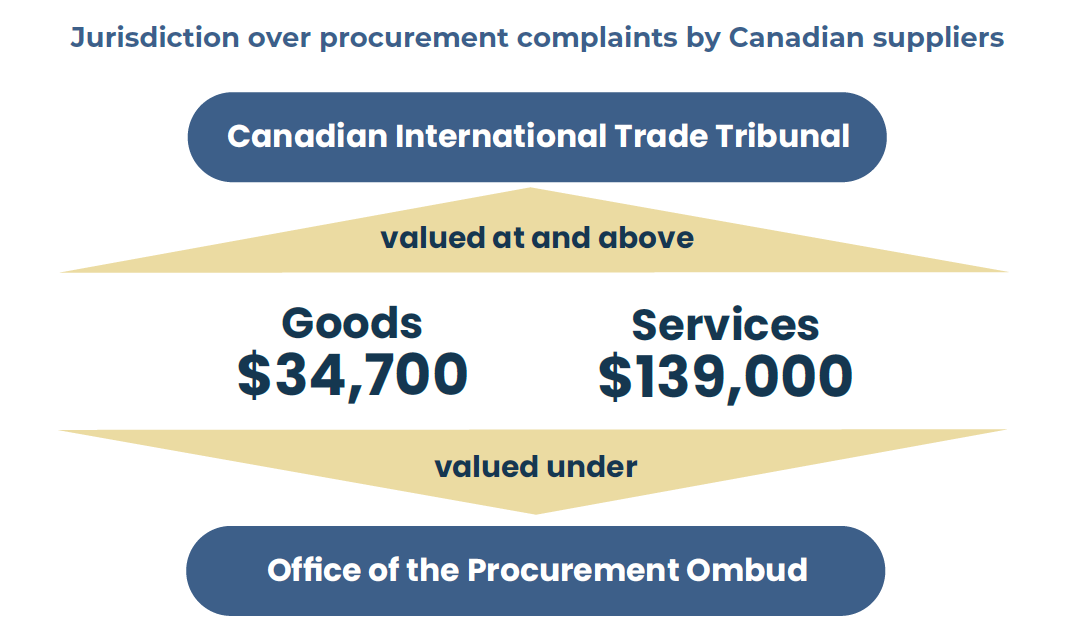
Since October 1, 2020, the Office of the Procurement Ombud (OPO) and the Tribunal have worked under a Memorandum of Understanding (MOU). The MOU aims to ease potential suppliers’ access to the complaint review system administered by both organizations. It also provides for continued cooperation between OPO and the Tribunal. The Tribunal and OPO have jurisdiction over procurement complaints brought by Canadian suppliers regarding the award of federal contracts, as follows:
Jurisdiction over procurement complaints by Canadian suppliers - text description
Monetary thresholds over procurement complaints by Canadian suppliers.
The Tribunal has jurisdiction over procurement complaints for goods valued at $34,700 and above and OPO has jurisdiction for goods valued under $34,700.
The Tribunal has jurisdiction over procurement complaints for services valued at $139,000 and above and OPO has jurisdiction for services valued under $139,000.
The Tribunal has exclusive jurisdiction over complaints by foreign suppliers about government procurement processes under applicable trade agreements. When filing a complaint with either OPO or the Tribunal, complainants are given the option to share their contact information and the basic nature of their complaint with the other organization. This exchange enhances access to justice by ensuring that complainants are filing their complaints in the right place and, most importantly, in the timeliest manner possible. During this fiscal year, a majority of complainants used this service.
Officials from OPO, the Tribunal and the ATSSC have continued to meet in 2025-26 to discuss each organization’s jurisdiction and how to ensure that parties have better access to avenues of recourse.
Historical trend: Procurement complaints received
The Tribunal’s caseload for its procurement review mandate remains relatively consistent with historical trends for the last ten years.
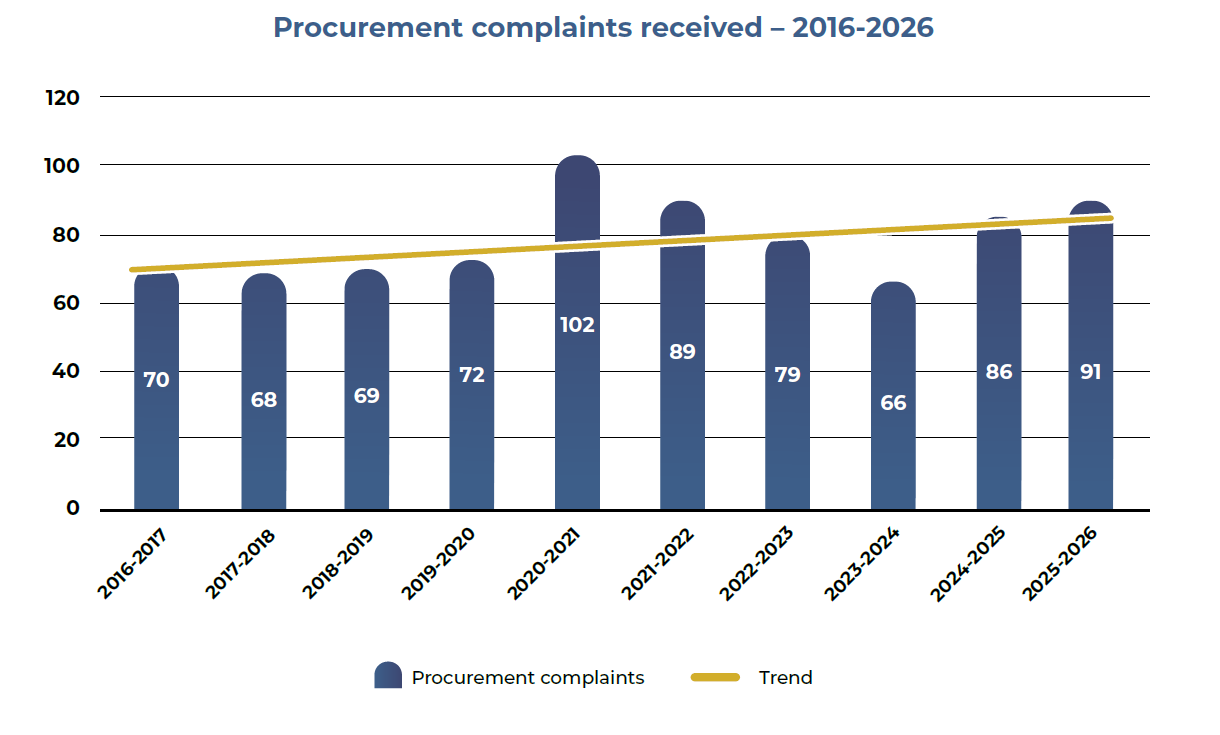
Procurement complaints received – 2016-2026 - text description
Bar chart of procurement complaints received from 2016 to 2026 and trend.
- 2016–2017: 70
- 2017–2018: 68
- 2018–2019: 69
- 2019–2020: 72
- 2020–2021: 102
- 2021–2022: 89
- 2022–2023: 79
- 2023–2024: 66
- 2024–2025: 86
- 2025–2026: 91
Procurement review activities in 2025-26
| Carried over from previous fiscal year | 10 |
|---|---|
| Received during this fiscal year | 91 |
| Total | 101 |
| Disposed during this fiscal year | 92 |
| Outstanding at the end of fiscal year | 9 |
| Total decisions issued | 49 |
|---|---|
| Premature/late filing | 11 |
| Lack of jurisdiction/not a potential supplier/not a designated contract | 7 |
| No reasonable indication of a breach | 31 |
| Withdrawn/abandoned | 15 |
| Total decisions issued | 28 |
|---|---|
| Ceased | 13 |
| Not valid/dismissed | 10 |
| Valid or valid in part | 5 |
Complaints received – self-represented parties
Of note, this year saw a continuation in a growing trend experienced by the Tribunal. Of the 91 complaints received this year, 76 were filed by self-represented parties. In that regard, to support such parties, the Tribunal’s website includes a set of guidelines describing the Tribunal’s procurement inquiry mandate and procedures. Potential complainants will also find on the Tribunal’s website a procurement complaint form, in multiple formats, with a comprehensive set of instructions that they can rely on to present their case to the Tribunal.
Compensation
Where the Tribunal determines that a procurement complaint is valid, it may recommend remedies, including payment of compensation to the complainant. Amendments to the Canadian International Trade Tribunal Procurement Inquiry Regulations that came into force in 2025 established maximum compensation award amounts. Before ruling on compensation amounts, the Tribunal often allows the parties to negotiate an amount of compensation to be paid, intervening only when an agreement cannot be reached.
The Tribunal recommended compensation as a remedy in one inquiry: Resolution Alliance Inc. v. Department of Employment and Social Development (PR-2025-001). The proceeding to determine the amount of recommended compensation was ongoing at the end of the fiscal year.
| Carried over from previous fiscal year | 3 |
|---|---|
| Initiated during this fiscal year | 1 |
| Total | 4 |
| Disposed during this fiscal year | 2 |
| Ongoing at the end of fiscal year | 2 |
Noteworthy decisions under the procurement review mandate
Samdesk Canada Inc. v. Department of Public Works and Government Services (PR‑2025‑011)
The Canadian International Trade Tribunal dismissed Samdesk Canada Inc.’s procurement complaint for lack of jurisdiction, finding that Samdesk was not a “potential supplier” and therefore had no standing to bring the complaint. Although the complaint was dismissed on this basis, the Department of Public Works and Government Services (PWGSC) also requested that the Tribunal dismiss the complaint on the basis of a National Security Exception (NSE). The decision includes important cautionary comments to the government on the use of the NSE and early guidance on the Tribunal’s new cost provisions.
The complaint related to a sole‑source software‑as‑a‑service (SaaS) contract and later extension awarded to Data Centre Intelligence Inc. under the federal SaaS Request for Supply Arrangement (RFSA) for software used by the Department of National Defence. Samdesk had provided the Department with an extended free trial of its software and believed it would be invited to compete in an upcoming competitive procurement.
Applying paragraph 10(1)(b) of the Canadian International Trade Tribunal Procurement Inquiry Regulations (Regulations), the Tribunal held that Samdesk lacked standing because it was not pre‑qualified under the RFSA. While Samdesk may have had the technical and financial capability to perform the work, it lacked the capacity to submit a bid, since only suppliers holding a valid supply arrangement could bid or be awarded contracts under the RFSA. The Tribunal acknowledged that the government did not inform Samdesk of the existence of the RFSA during its free trial of Samdesk’s software, but also cautioned Samdesk that it was ultimately responsible to inform itself regarding the government’s software procurement strategy.
With respect to PWGSC’s arguments that the Tribunal did not have jurisdiction due to a NSE, the Tribunal expressed concerns about whether the NSE had been “properly invoked” under subsections 10(2) and 10(3) of the Regulations. The Tribunal questioned the lack of a clear connection between the NSE letters and the specific procurement, the absence of supporting evidence, and the fact that public contract notices stated that no trade agreement exceptions applied to the procurement. The Tribunal warned that NSEs are extraordinary measures that must be invoked transparently and consistent with public disclosures.
Finally, although PWGSC sought costs, the Tribunal declined to award them. It held that dismissal for failure to meet a condition of inquiry is different from a finding that a complaint lacks merit. Thus, the Tribunal retained discretion on the awarding of costs. In this case, the Tribunal ordered each party to bear its own costs, citing ambiguity and incomplete disclosure by the government in the procurement process.
École de langues Eagle Inc. (PR‑2025‑016) and École de Langues La Cité Inc. (PR‑2025‑069)
These two Tribunal decisions arise from the same request for standing offers for second‑language training services, but they have two different outcomes.
École de langues Eagle Inc.
This is a classic evaluation case and a strong reminder of core principles for evaluators.
École de langues Eagle Inc. (ELE) challenged PWGSC’s decision to declare its bid non‑compliant for failing to meet the minimum score under several rated technical criteria (RTC 1 to 5). The Tribunal found that the evaluation was unreasonable and therefore inconsistent with the Canadian Free Trade Agreement.
The Tribunal identified several reviewable errors:
- Evaluators applied an overly narrow interpretation of RTC 1.
- They improperly excluded hours described as “skill maintenance” even though the request for standing offers did not prohibit counting such experience.
- They also failed to consider relevant information found elsewhere in the proposal, including curriculum tables and annexes, contrary to their duty of diligence.
- PWGSC wrongly rejected valid clarifications that pointed to required information and did not amount to impermissible bid repair.
While the Tribunal reiterated its general deference to evaluators, it emphasized that it would intervene when evaluators misinterpret a criterion, rely on undisclosed requirements or ignore vital information in a bid. The Tribunal recommended a re‑evaluation of ELE’s bid, with the possibility of awarding a standing offer if ELE ranked highest after correction, and it awarded costs.
École de langues La Cité Inc.
École de langues La Cité Inc. (La Cité), the original successful bidder, filed a complaint after its standing offers were set aside following the implementation of the ELE decision. Notably, La Cité had declined to intervene in the proceeding brought by ELE despite being formally invited by the Tribunal to do so.
The Tribunal declined to inquire in this case for the following reasons:
- several grounds of complaint were time-barred;
- allegations concerning lack of transparency and transition measures related to the administration of the contract after award, which falls outside the definition of “procurement process” under the amended Regulations; and
- the re‑evaluation itself was not unfair, as it simply implemented the Tribunal’s prior instructions.
The Tribunal emphasized that suppliers who choose not to intervene in proceedings that may affect their contractual rights assume a real risk and may not be able to later seek to reopen decided issues.
Rochester Midland Canada Corporation (PR‑2025‑049)
This decision addresses the proper interpretation of phased offer compliance processes (POCP) and confirms that such mechanisms must be applied in accordance with their express terms. The complaint concerned a request for proposals issued by PWGSC for chemical water and glycol treatment services in the National Capital Region. The Tribunal held that, where a solicitation permits bidders to provide “additional or different information” following a compliance assessment report (CAR), restrictions on what may be submitted must be clearly stated.
Rochester Midland Canada Corporation’s bid was found non‑compliant for failing to demonstrate that it had two qualified technicians. In response to the CAR, it submitted missing certifications for one technician and proposed a substitute technician after one resource became unavailable. PWGSC rejected the substitution as impermissible bid repair.
The Tribunal found the complaint valid in part as PWGSC’s interpretation was unreasonable. The POCP expressly allowed bidders to submit “additional or different information” that would replace the original information and did not, on a proper reading of the POCP as a whole, prohibit substitution. The Tribunal’s decision clarifies that traditional bid repair constraints must be applied considering any POCP mechanism included in the solicitation.
The Tribunal also found the complaint timely, as PWGSC’s communications reasonably suggested the bid remained under evaluation until the formal regret letter. Other grounds, relating to procedural fairness and price comparison, were dismissed.
Although a breach was established, no re‑evaluation was ordered because the complainant would not have been successful on price. The Tribunal instead recommended that procuring entities must both clearly define and strictly apply any limits on POCPs.
Customs and excise appeals
The Tribunal hears and decides appeals of decisions of the President of the Canada Border Services Agency (CBSA) and the Minister of National Revenue.
1) Appeals filed under the Customs Act (AP)
Appeals filed under the Customs Act relate to a range of issues:
- appropriate classification of imports according to the Customs Tariff;
- appropriate manner in which to calculate the value for duty of imports;
- determination of where imports originated before they entered Canada; and
- importation of prohibited goods (such as certain pocketknives and weapons).
There were 33 appeals filed under the Customs Act in 2025-26.
2) Appeals filed under the Special Import Measures Act (EA)
Appeals filed under the Special Import Measures Act (SIMA) relate to two key issues:
- whether certain goods fall within the scope of trade remedy measures; and
- whether the CBSA properly calculated the margin of dumping, amount of subsidy or export price for certain imports.
Twenty-one appeals were filed under SIMA in 2025-26, marking, by far, the highest number ever received in a single fiscal year.
3) Appeals filed under the Excise Tax Act (AP)
Appeals filed under the Excise Tax Act relate to an assessment or a determination of excise tax.
No appeals were filed under this act in 2025-26.
4) Extensions of time (EP)
Under the Customs Act, a person may apply to the Tribunal for an extension of time to file a request for a re-determination or a further re-determination with the CBSA. The Tribunal may grant such an application after the CBSA has refused an application or when 90 days have elapsed after the application was made and the person has not been notified of the CBSA’s decision. A person may also apply to the Tribunal for an extension of time within which to file a notice of appeal.
There were 3 requests for an extension of time filed before the Tribunal in 2025-26.
Historical trend: Appeals received
The Tribunal’s caseload for its customs and excise appeals mandate remains relatively consistent with historical trends for the last ten years.
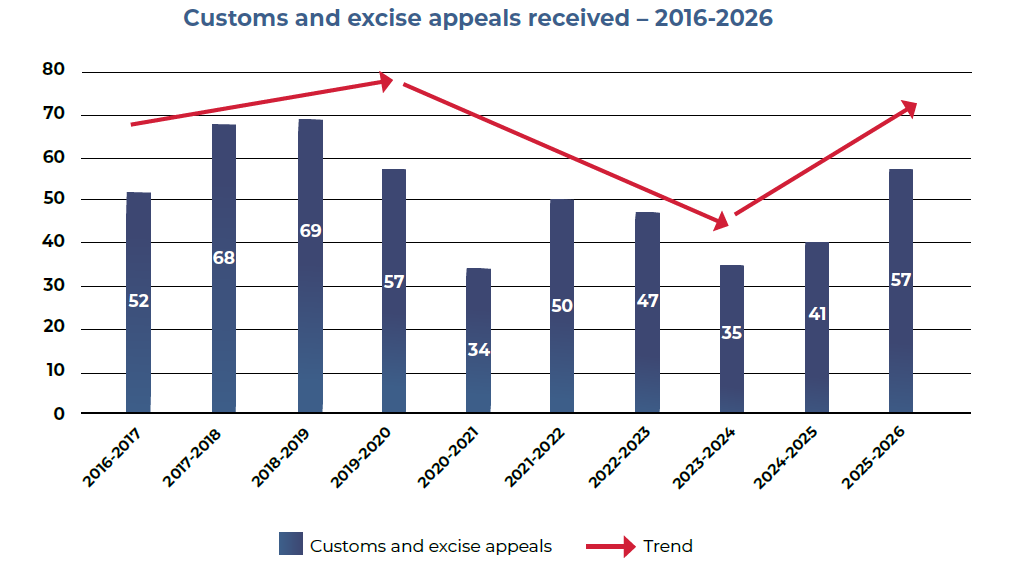
Customs and excise appeals received – 2016-2026 - text description
Bar chart of customs and excise appeals received from 2016 to 2026 and trend.
- 2016–2017: 52
- 2017–2018: 68
- 2018–2019: 69
- 2019–2020: 57
- 2020–2021: 34
- 2021–2022: 50
- 2022–2023: 47
- 2023–2024: 35
- 2024–2025: 41
- 2025–2026: 57
Appeals received, heard and scheduled
During the fiscal year, the Tribunal received 57 appeals. Ninety-one appeal cases were outstanding at the end of the fiscal year. Of that number, 11 were in abeyance at the request of the parties, often because parties were attempting to negotiate a settlement or were awaiting the outcome of another related appeal before the Tribunal. The remaining 80 matters were all progressing.
| Cases brought forward from previous fiscal year | Cases received in fiscal year | Total | Total decisions issued | Cases withdrawn/ closed/no longer in abeyance | Cases outstanding (March 31, 2026) | |
|---|---|---|---|---|---|---|
| Customs Act (AP) | 41 | 33 | 74 | 10 | 10 | 54 |
| In abeyance | 6 | 7 | ||||
| Decision pending | 16 | 23 | ||||
| Scheduled | 13 | 19 | ||||
| To be scheduled | 6 | 5 | ||||
| Special Import Measures Act (EA) | 17 | 21 | 38 | 1 | 2 | 35 |
| In abeyance | 3 | 4 | ||||
| Decision pending | 7 | 14 | ||||
| Scheduled | 3 | 11 | ||||
| To be scheduled | 4 | 6 | ||||
| Excise Tax Act | 1 | 0 | 1 | 0 | 0 | 1 |
| Extension of time | 0 | 3 | 3 | 0 | 2 | 1 |
Noteworthy decisions under the customs and excise appeals mandate
Atrium Innovations Inc. (AP‑2021‑032 and AP‑2022‑026) and Nature’s Way of Canada Limited (AP‑2022‑041)
These decisions clarify the relationship between the Customs Tariff, World Customs Organization Harmonized System Explanatory Notes and Canadian jurisprudence. They also address jurisdiction, mootness, and further identifies what can constitute implied decisions by the Canada Border Services Agency (CBSA).
Core classification issue
The central issue in the appeals was the CBSA’s claim that 2019 amendments to the WCO Explanatory Notes changed the legal test for classifying goods as “medicaments” under tariff heading 30.04. The CBSA argued that, after the amendments, products such as fish oil capsules, omega‑3 supplements, ashwagandha, and coenzyme Q‑10 should be classified as food preparations under heading 21.06 unless their scientific efficacy was proven.
The Tribunal rejected that position. It held that the Customs Tariff is the governing law and that the long‑standing Canadian “plausible use” test remains the legal standard. Under that test, goods qualify as medicaments if they are recognizable as products for therapeutic or prophylactic use, without requiring proof of clinical efficacy.
Interpretation of the Explanatory Notes
The Tribunal emphasized that the Explanatory Notes are non‑binding interpretive aids that cannot amend legislation or overturn binding jurisprudence unless explicitly incorporated into Canadian law under subsection 14(1) of the Customs Tariff. As a result, the amendments were inoperative in Canada.
Jurisdiction and mootness
The Tribunal also rejected the CBSA’s jurisdictional and mootness arguments. It confirmed that CBSA decisions may contain implied determinations with ongoing effects, that the Tribunal has de novo jurisdiction over the entire customs accounting decision (classification, origin and value for duty), and that an importer remains “aggrieved” where CBSA directions continue to affect future importations.
Outcome
In these cases, the Tribunal held that the goods were medicaments under heading 30.04 and ordered refunds of duties. The decisions reaffirm the primacy of statutory text and settled jurisprudence over administrative reinterpretation.
These decisions are under appeal to the Federal Court of Appeal.
Major Pipe & Supply Ltd. (EA‑2024‑004)
This decision answers a recurring jurisdictional question under the Special Import Measures Act (SIMA): what happens when the CBSA fails to issue a re‑determination within the one‑year timeline set out in subsection 59(3)?
Major Pipe & Supply Ltd. (MPS) argued that the CBSA’s failure to meet the one‑year deadline shouldstrip the President of authority to act, require the Tribunal to terminate the re‑determination and appeal process, and result in an immediate refund of anti‑dumping duties. In the alternative, MPS argued that the delay constituted a “non‑decision” appealable to the Tribunal.
The Tribunal rejected both arguments.
First, the Tribunal held that subsection 59(3) of SIMA is directory, not mandatory. Although the provision uses the word “shall”, SIMA does not specify any consequence for non‑compliance, and Parliament did not intend the President to lose jurisdiction because of delay. As a result, the President may validly issue a re‑determination after the one‑year period has expired. The Tribunal also confirmed that it has no authority to terminate the statutory re‑determination and appeal process or to order refunds before a proper re‑determination is made.
The Tribunal emphasized that SIMA serves a broader public purpose beyond resolving disputes with importers. Its central objective is protecting domestic producers. Ending the process due to administrative delay would undermine that purpose and prejudice parties who have no control over CBSA timelines.
Second, the Tribunal held that the mere passage of time does not give rise to an appealable “non‑decision” under SIMA. SIMA contains no deeming provision that treats delay as a refusal or negative decision. In doing so, the Tribunal expressly declined to follow earlier Customs Act cases (notably, Frito‑Lay and Wolseley) that had characterized delay as a reviewable non‑decision.
Finally, the Tribunal clarified that the appropriate remedy for excessive delay is an application to the Federal Court for a writ of mandamus compelling the President to act.
Safeguard reference
International trade rules allow Canada to temporarily restrict imports to allow Canadian producers to adapt to increased imports which cause or threaten to cause serious injury. These temporary measures are called safeguards. The Tribunal has the authority to inquire into safeguard complaints from Canadian producers, as well as safeguard references from the Government of Canada. Complaints from Canadian producers can cover imports from all countries (global safeguards) or just imports from countries with which Canada has signed a free trade agreement (bilateral safeguards). When directed by the Government, the Tribunal may also recommend appropriate remedies to offset the harmful effects of import surges.
On March 13, 2026, the Tribunal was directed by the Order Referring the Matter of the Importation of Certain Vegetable Goods to the Canadian International Trade Tribunal, P.C. 2026-0209 (Order), to conduct a safeguard inquiry concerning the importation into Canada of certain vegetable goods. On March 16, 2026, the Tribunal initiated the safeguard inquiry.
The purpose of the inquiry is to determine whether these goods were imported into Canada in such increased quantities and under such conditions as to be a principal cause of serious injury or threat thereof to domestic producers of such goods.
The Order referred to the Tribunal:
- Directs the Tribunal to have regard to Canada’s international trade rights and obligations.
- Requires the Tribunal, in the event it determines that there was an increase in imports, and serious injury or threat thereof, to make separate determinations regarding subject imports originating in certain free trade agreement partners.
- Outlines specific treatment for imports from countries benefiting from the General Preferential Tariff (GPT).
- Instructs the Tribunal not to hear any motion to exclude any good from the class or that would otherwise limit the scope of the inquiry, determination or recommendations.
- Directs the Tribunal to provide recommendations as to the most appropriate remedy to address, over a period of three years, the injury if ultimately, the inquiry shows that imports of the subject goods caused or threatened to cause serious injury. The Order further directs the Tribunal to consider the effect of the remedy on the affordability for consumers of certain vegetable goods, and on food security.
A public hearing for this safeguard inquiry will begin on June 15, 2026. The Tribunal will report its findings, and any recommendations, to the Governor in Council on September 9, 2026.
Judicial reviews and appeals
Judicial or panel reviews of Tribunal decisions
Any person affected by Tribunal findings or orders issued under the Special Import Measures Act (SIMA) can apply for judicial review by the Federal Court of Appeal (FCA) on grounds of, for instance, denial of natural justice or error of law. Any person affected by Tribunal procurement findings and recommendations under the Canadian International Trade Tribunal Act can similarly request judicial review by the FCA under sections 18.1 and 28 of the Federal Courts Act. Lastly, Tribunal orders and decisions made pursuant to the Customs Act can be appealed under that act to the FCA or, under the Excise Tax Act, to the Federal Court.
This year again, a small proportion (11 out of 243 or 4.53%) of the Tribunal decisions were appealed to a reviewing court.
Active at beginning of 2025-26 | Filed during 2025-26 | Disposed during 2025-26 | Outstanding at the end of 2025-26 | |||
|---|---|---|---|---|---|---|
Withdrawn | Allowed | Dismissed | ||||
| SIMA | 0 | 1 | 0 | 0 | 0 | 1 |
| Procurement | 4 | 7 | 3 | 1 | 1 | 6 |
| Appeals | 3 | 5 | 0 | 1 | 1 | 6 |
| Total | 7 | 13 | 3 | 2 | 2 | 13 |
Judicial reviews of Special Import Measures Act cases
One application for judicial review was filed with the FCA on February 2, 2026, regarding the Tribunal’s finding in Carbon or Alloy Steel Wire (NQ-2025-003).
| NQ-2025-003 | |
|---|---|
| Product | Certain Carbon or Alloy Steel Wire |
| Date of Tribunal’s decision | January 2, 2026 |
| FCA court status | Pending |
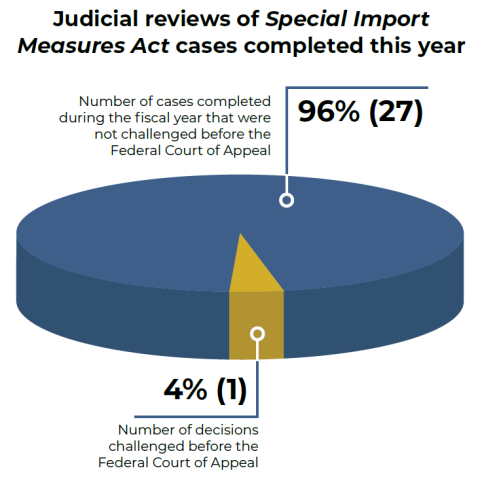
Judicial reviews of Special Import Measures Act cases completed this year - text description
Pie chart of judicial reviews of Special Import Measures Act cases completed this year.
Of the 27 decisions issued by the Tribunal under this mandate, one was challenged before the Federal Court of Appeal and is pending.
Judicial reviews of procurement complaints
A total of five Tribunal decisions were challenged before the Federal Court of Appeal during this fiscal year. One of these applications was since discontinued by the applicant, and four remain outstanding at the end of the fiscal year.
| PR-2024-056 | PR-2025-001 | PR-2025-001 | PR-2025-051 | PR-2025-068 | |
|---|---|---|---|---|---|
| Complainant | Primex Project Management Ltd. | Resolution Alliance Inc. | Cadex Inc. | Denys Petika Management, Administration, Consulting Inc. | Denys Petika Management, Administration, Consulting Inc. |
| Date of Tribunal’s decision | April 7, 2025 | August 12, 2025 | November 17, 2025 | November 26, 2025 | March 20, 2026 |
| FCA court status | Discontinued | Pending | Pending | Pending | Pending |
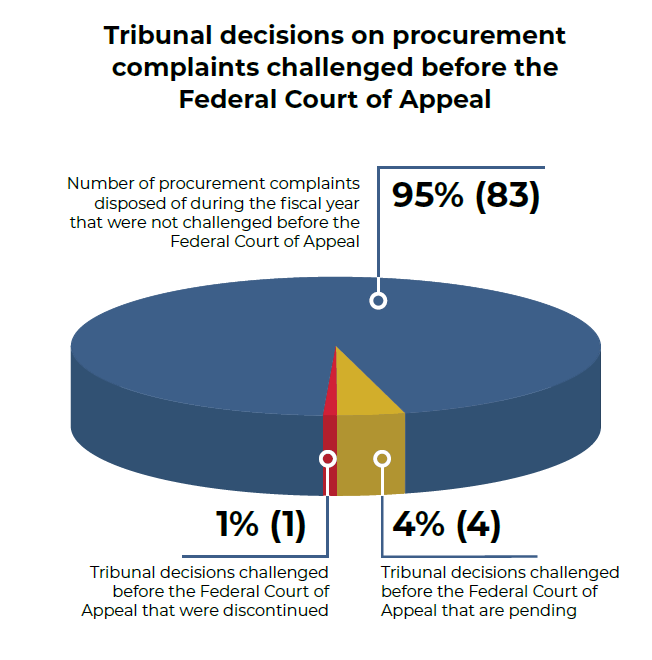
Tribunal decisions on procurement complaints challenged before the Federal Court of Appeal - text description
Pie chart of judicial reviews of procurement decisions issued during the fiscal year.
Of the 83 decisions issued by the Tribunal under this mandate, one was challenged before the Federal Court of Appeal and discontinued, and four were challenged before the Federal Court of Appeal and are pending.
During this fiscal year, four applications for judicial review of Tribunal decisions filed in a previous fiscal year came to a close. The FCA dismissed the application for judicial review of the Tribunal’s decision in Hakson Safety Wears Inc. v. Department of Public Works and Government Services (PR-2024-024). The FCA allowed the application for judicial review of the Tribunal’s decision in ADGA Group Consultants Inc. v. Department of Public Works and Government Services (PR-2024-038). Two further applications were discontinued by the applicants.
Appeals of Customs Act and Special Import Measures Act appeal decisions
Three of the Tribunal’s decisions rendered this fiscal year under this mandate were challenged in the FCA.
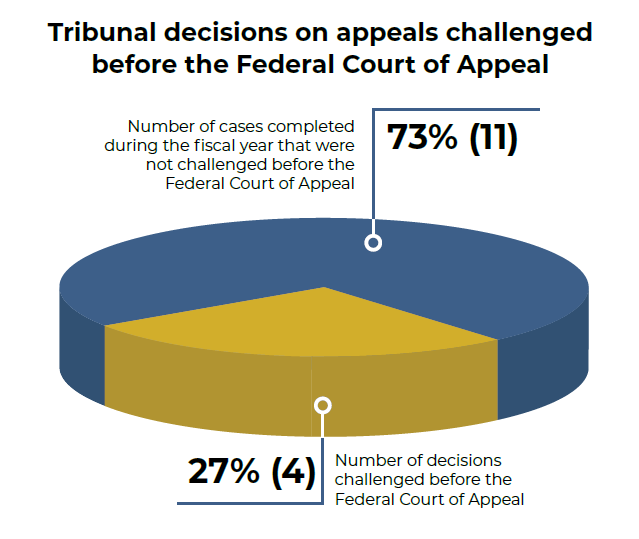
Tribunal decisions on appeals challenged before the Federal Court of Appeal - text description
Pie chart of appeals of customs and excise appeal decisions during the fiscal year.
Of the 11 decisions issued by the Tribunal under this mandate, four were challenged before the Federal Court of Appeal.
EA-2019-002 | AP-2021-032 and AP-2022-026 | AP-2022-041 | |
|---|---|---|---|
| Appellant | 2045662 Alberta Inc. | Atrium Innovations Inc. | Nature’s Way of Canada Limited |
| Date of Tribunal’s decision | September 11, 2025 | November 7, 2025 | November 7, 2025 |
| FCA court status | Pending | Pending | Pending |
During this fiscal year, the FCA rendered decisions on two proceedings initiated in previous years. The FCA allowed the appeal in B. Cooper. v. President of the Canada Border Services Agency (AP-2022-039) and dismissed the application in Major Pipe & Supply Ltd. v. President of the Canada Border Services Agency (EA-2024-004).
Contact us
Canadian International Trade Tribunal
333 Laurier Avenue West, 17th Floor
Ottawa, Ontario K1A 0G7
Telephone: 613-993-3595
Toll-free: 1-855-307-2488
Fax: 613-990-2439
Email: citt-tcce@tribunal.gc.ca
Website: citt-tcce.gc.ca/en
Glossary
Anti-dumping duties
Duties in the form of a tax on imported goods that were dumped on the Canadian market and subject to a finding of injury of the Tribunal. The application of anti-dumping duties is intended to offset the amount of dumping on imported goods and give the goods produced in Canada an opportunity to compete fairly with the imported goods.
Countervailing duties
Duties in the form of a tax on imported goods that were subsidized and subject to a finding of injury of the Tribunal. The application of countervailing duties is intended to offset the amount of subsidizing on imported goods and give the goods produced in Canada an opportunity to compete fairly with the imported goods.
Decision, determination, finding and order
A decision is a judgment made by the Tribunal in the context of its mandates, including on any matter that arises during a proceeding.
A determination is a Tribunal decision resulting from a preliminary injury inquiry under the Special Import Measures Act (SIMA) or an inquiry into a procurement complaint.
A finding is a Tribunal decision resulting from a final injury inquiry under SIMA.
An order is a Tribunal decision resulting from an expiry, an expiry review or an interim review. It can also be a procedural decision in any type of case under the Tribunal’s mandates.
Designated contract
A contract for the supply of goods or services that has been or is proposed to be awarded by a government institution.
Judicial review
A review of a Tribunal decision by the Federal Court of Appeal or Federal Court.
Potential supplier
A bidder or prospective bidder on a designated contract.
Quasi-judicial
A partly judicial character by having the right to hold hearings on and conduct investigations into disputed claims and alleged infractions of statutes and to make decisions in the general manner of courts.
Remand (verb)
To send a case to another court. A party displeased with a Tribunal decision can ask the Federal Court of Appeal to overturn it. The Court can overturn that decision itself or refer it back (“remand it”) to the Tribunal with or without instructions on how it should decide the matter again.
Annex
Orders and rulings issued in 2025-26
The tables below contain statistics pertaining to orders and rulings on procedural matters issued as part of the Tribunal’s proceedings during fiscal year 2025-26. These statistics illustrate the complexity of the cases considered by the Tribunal.
| Trade remedy activities | Procurement review activities | Appeals | Total | |
|---|---|---|---|---|
| Orders | ||||
| Disclosure orders | 51 | 0 | 0 | 51 |
| Cost award orders | N/A | 10 | N/A | 10 |
| Compensation orders | N/A | 0 | N/A | 0 |
| Production orders | 26 | 0 | 0 | 26 |
| Postponement of award orders | N/A | 7 | N/A | 7 |
| Rescission of postponement of award orders | N/A | 6 | N/A | 6 |
| Directions/administrative rulings | ||||
| Requests for information | 114 | 0 | 0 | 114 |
| Motions | 0 | 5 | 1 | 6 |
| Subpoenas | 8 | 0 | 0 | 8 |
Other statistics
| 2025-26 | 2024-25 | 2023-24 | 2022-23 | 2021-22 | |
|---|---|---|---|---|---|
| Public hearing days | 27 | 17 | 16 | 19 | 34 |
| File hearings | 19 | 11 | 4 | 7 | 18 |
| Witnesses | 99 | 61 | 54 | 73 | 111 |
| Participants | 220 | 106 | 53 | 71 | 204 |
| Questionnaire replies | 644 | 500 | 251 | 251 | 552 |
| Pages of official records | 494,079 | 370,913 | 178,495 | 210,227 | 287,196 |
| 2025-26 | 2024-25 | 2023-24 | 2022-23 | 2021-22 | |
|---|---|---|---|---|---|
| Public hearing days | 0 | 4 | 1 | 0 | 2 |
| File hearings | 80 | 61 | 55 | 73 | 87 |
| Witnesses | 0 | 8 | 0 | 0 | 1 |
| Participants | 136 | 115 | 88 | 111 | 158 |
| Questionnaire replies | 0 | 0 | 0 | 0 | N/A |
| Pages of official records | 71,938 | 55,693 | 55,416 | 73,473 | 86,255 |
| 2025-26 | 2024-25 | 2023-24 | 2022-23 | 2021-22 | |
|---|---|---|---|---|---|
| Public hearing days | 20 | 11 | 25 | 15 | 16 |
| File hearings | 3 | 10 | 14 | 10 | 6 |
| Witnesses | 27 | 12 | 34 | 14 | 19 |
| Participants | 50 | 70 | 133 | 86 | 86 |
| Questionnaire replies | 0 | 0 | 0 | 0 | N/A |
| Pages of official records | 34,450 | 17,326 | 48,376 | 54,263 | 27,193 |
| 2025-26 | 2024-25 | 2023-24 | 2022-23 | 2021-22 | |
|---|---|---|---|---|---|
| Public hearing days | 47 | 32 | 42 | 34 | 52 |
| File hearings | 102 | 82 | 73 | 90 | 111 |
| Witnesses | 126 | 81 | 88 | 87 | 131 |
| Participants | 406 | 291 | 274 | 267 | 448 |
| Questionnaire replies | 644 | 500 | 251 | 251 | 552 |
| Pages of official records | 600,467 | 478,993 | 282,287 | 337,963 | 400,644 |